Crafting Effective Back to School Web Banner Templates for Modern Educational Campaigns
Why Visual Communication Matters During the Back to School Season
The back to school period represents one of the most competitive marketing windows of the year. Schools, tutoring centers, supply retailers, and online learning platforms all compete for attention. A Back to School Web Banner Template serves as the visual anchor for these campaigns. It must convey urgency, excitement, and reliability within a fraction of a second. Parents are scrolling through social feeds, educators are searching for classroom resources, and students are looking for inspiration. The banner is often the first touchpoint. If it fails to communicate clearly, the entire campaign suffers. This is why understanding how to structure and customize a back to school web banner template is essential for anyone involved in educational marketing or admissions outreach.
Core Characteristics of an Effective Template
A professional Back to School Web Banner Template typically includes layered typography, iconography related to learning, and a color palette that balances warmth with academic seriousness. Many templates come as EPS CC files, which means they are fully compatible with Adobe Illustrator Creative Cloud. This format allows vector-based editing, so scaling the banner for different screen sizes does not degrade image quality. Common design elements include chalkboard textures, apple icons, pencil motifs, and book stacks. These visuals trigger immediate associations with education. The best templates also incorporate free fonts, which reduce licensing concerns and keep production costs low. When you choose a back to school web banner template that includes font names in the documentation, you can replicate the exact look without purchasing additional typefaces.
EPS CC Version and Layered Editing
The EPS CC version is a significant advantage for designers. Unlike flattened JPEG or PNG files, an EPS file preserves individual layers. You can turn off the background layer, adjust the color of a single text element, or swap an illustration without affecting the rest of the design. This level of control is critical when you need to adapt a single template for multiple platforms. For example, the same Back to School Web Banner Template might be used for a Facebook cover image, an Instagram story, and a website hero section. Each platform has different aspect ratios. With a layered EPS CC file, you can rearrange elements to fit each format while maintaining visual consistency. This workflow saves hours of redesign work and ensures that your campaign looks coherent across all channels.
Fully Editable and Professional Output
When a template is described as fully editable and professional, it means that every component is intended for modification. Text layers can be updated with your own messaging. Colors can be shifted to match your brand guidelines. Images placeholders are clearly marked so you can drop in your own photography or illustrations. This flexibility is particularly valuable for small businesses and independent educators who do not have a dedicated design team. Instead of starting from a blank canvas, you begin with a polished framework. The professional appearance of a well-made back to school web banner template lends credibility to your institution or store. A poorly designed banner can make even the best offer look amateurish. Investing in a quality template is an investment in trust.
Practical Uses Across Educational and Commercial Contexts
The applications of a Back to School Web Banner Template extend far beyond traditional school advertising. Private tutoring services use these banners to announce enrollment periods. Online course platforms promote new semesters with them. Bookstores highlight back to school sales. Even nonprofit organizations focused on literacy use educational banner templates to drive donations during the back to school season. The visual language of education—pencils, books, caps, and bright colors—resonates with anyone who values learning. This makes the template versatile. You can adapt it for a kindergarten open house, a university scholarship announcement, or a STEM workshop registration drive. The core design remains the same, but the messaging and imagery shift to match the audience.
Social Media Advertising and Admissions Posts
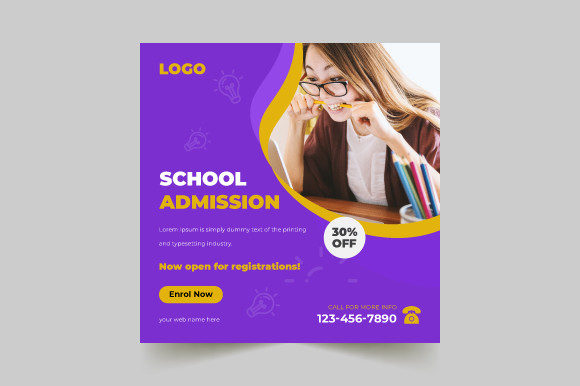
Social media platforms are visual by nature. A Back to School Web Banner Template designed for social media posts often includes space for a call-to-action button overlay, captions, and branding. For admissions campaigns, the banner needs to highlight key dates, program names, and a compelling reason to apply. Templates that include graduation caps, diploma scrolls, or diverse student silhouettes are particularly effective for higher education. They signal inclusivity and academic achievement. When you use a back to school web banner template for an admissions post, you are not just sharing information. You are building a narrative about opportunity and growth. The banner becomes a visual promise of what the student can expect.
Email Newsletter Headers and Website Banners
Email marketing remains one of the highest-converting channels for educational institutions. A banner template at the top of a newsletter sets the tone for the entire message. If the email announces early bird registration, the banner should convey urgency without anxiety. A clean layout with bold numbers and a clear headline works well. On websites, the banner often occupies the hero section. It must load quickly and be responsive. A vector-based Back to School Web Banner Template exported as SVG or high-resolution PNG ensures sharp display on retina screens. Many professional templates include guidelines for safe zones—areas where text will not be cut off by different screen sizes. This attention to detail separates a good template from a great one.
Advantages of Using a Pre-Made Template
Time savings are the most obvious benefit. Designing a custom banner from scratch can take several hours, especially if you are not proficient in graphic design software. A pre-made back to school web banner template reduces that time to minutes. You simply open the file, edit the text, adjust colors if needed, and export. This speed is crucial during the back to school rush when deadlines are tight. Additionally, templates expose you to design trends you might not have considered. The arrangement of elements, the choice of fonts, and the color combinations are often based on current best practices in visual communication. Using a template is a learning opportunity as much as a production tool.
Cost Efficiency and Accessibility
Hiring a professional designer for a single banner can cost anywhere from fifty to several hundred dollars. A template, especially one that includes free fonts, costs a fraction of that. Many high-quality templates are available for download at very low prices, and some are even offered for free as promotional items. This makes professional design accessible to schools with limited budgets, parent-teacher associations, and independent educators. The phrase Back to School Web Banner Template has become a search term that connects cost-conscious creators with affordable design resources. By using such a template, you allocate more of your budget to the actual program or product rather than to marketing materials.
Considerations When Choosing a Template
Not all templates are created equal. Before downloading a back to school web banner template, check the file format. EPS CC is ideal for vector editing, but if you use Affinity Designer or CorelDRAW, you may need a different format. Also verify that free fonts are clearly named and linked. Some templates use fonts that are free for personal use but require a license for commercial campaigns. Read the terms carefully. Another consideration is the level of customization. A template with too many locked layers can be frustrating. Look for files that advertise full editability. Professional templates often include a help file or readme document that explains which layers are which. This documentation is a sign of quality.
Color Schemes and Accessibility
Color choices in a Back to School Web Banner Template should align with your brand but also consider accessibility. High contrast between text and background improves readability for visually impaired viewers. Avoid placing light text over busy background patterns. Many modern templates use bold, saturated colors for headlines and neutral tones for backgrounds. This combination is both eye-catching and readable. If the template uses pastel gradients, test the banner on a mobile screen under bright sunlight. Subtle colors can wash out. A professional template will have been tested across devices, but it is always wise to preview your final export on multiple screens before launching the campaign.
Workflow for Customizing Your Template
Start by opening the EPS CC file in Adobe Illustrator. If you do not have Illustrator, you can use other vector software that supports EPS, though some features may be limited. Locate the layers panel and unlock all layers. Select the text layers and replace the placeholder copy with your own messaging. Keep headlines short—five to seven words maximum. Subheadings can be slightly longer. Next, adjust the color scheme. If the template uses a blue and yellow palette but your brand uses green and purple, change the relevant swatches. Use global colors if possible. They allow you to update every instance of a color by editing a single swatch. Finally, export the banner in the required format. For web use, PNG with transparent background is common. For print, export as PDF or EPS with embedded fonts.
Testing and Iteration
After customizing your back to school web banner template, test it in context. Place it on your website mockup or social media preview. Does the text read clearly? Is the call-to-action visible without scrolling? Ask a colleague to look at it for two seconds and describe what the banner is about. If they can articulate the main message, the design is working. If not, consider simplifying the layout. Sometimes less text and more whitespace improve comprehension. Iteration is normal. A single template can be adjusted multiple times before it performs optimally. The flexibility of an editable EPS CC file makes this iterative process smooth.
Trends in Educational Banner Design
The visual trends for back to school banners shift gradually. Currently, flat design with subtle shadows is popular. Gradients are making a comeback, especially in backgrounds. Illustrations of diverse students and modern classrooms are preferred over outdated clip art. Typography is moving toward bold, sans-serif fonts that are easy to read on small screens. Another trend is the inclusion of interactive elements in digital banners, such as countdown timers or animated transitions. While a static Back to School Web Banner Template cannot include animation, you can design the static version in a way that suggests motion—using diagonal lines, overlapping elements, or dynamic poses in illustrations. This keeps the design feeling current without requiring complex coding.
Mobile-First Thinking
More than half of back to school research happens on mobile devices. A banner that looks stunning on a desktop monitor may be illegible on a phone. When selecting a back to school web banner template, consider its performance at small sizes. Thick fonts, large icons, and minimal text are mobile-friendly. Templates that include both horizontal and vertical layouts are especially valuable because you can use the horizontal version for websites and the vertical version for mobile ads. Some designers create a square variation as well, which works well for Instagram and Facebook feeds. A versatile template set saves you from having to adjust the original file repeatedly.
Real-World Examples of Effective Use
A small community college in the Midwest used a single Back to School Web Banner Template to promote its fall enrollment. They customized the colors to match their school colors, added a photo of their campus, and changed the headline to "Your Future Starts Here." The banner was used on the website homepage, in email newsletters, and as a Facebook cover photo. Enrollment inquiries increased by 22 percent compared to the previous year when they had used a text-only announcement. This example illustrates how a professional visual presence can directly impact outcomes. Another example is an online tutoring company that used a template to create a series of banners for different grade levels. By changing only the headline and a few icons, they produced seven distinct banners in under an hour. The consistency across the series strengthened their brand identity.
Observations from Creator Communities
Designers who share back to school web banner template resources often emphasize the importance of leaving room for the message. A common mistake among beginners is to overcrowd the banner with too many decorative elements. The most effective templates balance visual interest with negative space. They guide the viewer's eye to the headline first, then to the supporting details, and finally to the call-to-action. This hierarchy is achieved through size, color contrast, and placement. Observing how experienced designers construct this hierarchy can improve your own use of templates. Pay attention to where the designer placed the school name, the date, and the button. Those choices are intentional.
Technical Specifications to Keep Handy
When you download a Back to School Web Banner Template, note its resolution and color mode. For web use, RGB color mode and 72 DPI are standard. For print, use CMYK and at least 300 DPI. Some templates include both versions in separate files. The EPS CC format typically preserves vector data, so you can switch between color modes without loss. Also check the dimensions. Common banner sizes include 728x90 pixels for leaderboards, 300x250 for medium rectangles, and 1200x630 for social sharing. If the template is a single size, you may need to resize it. Vector formats make resizing easy—simply group all layers and scale proportionally. Keep a backup of the original file before making major changes.
Building a Long-Term Resource Library
Familiarizing yourself with a quality back to school web banner template is not a one-time task. The template you use this year can be adapted for next year. Save the customized version and note what changes you made. The following year, open the saved file, update the date and messaging, and export again. This builds efficiency over time. You develop a library of proven designs that you know work for your audience. Additionally, collecting templates from different sources exposes you to varied design philosophies. Some templates are minimalist, some are playful, and others are academic. Having options allows you to match the tone to the specific campaign. Whether you are announcing a kindergarten playdate registration or a graduate school deadline, the right template sets the stage for effective communication.