Fifth Grade Dude, Back to School SVG: A Practical Guide to Formats, Use Cases, and Choosing the Right Design Resource
Back-to-school season brings a surge of creative projects, from personalized t-shirts and classroom decorations to scrapbook pages and gift items. Among the many design themes available, the "Fifth Grade Dude, Back to School SVG" stands out as a focused option for parents, teachers, and crafters who want to celebrate that milestone year. But as with any digital design resource, understanding what you are actually getting—and whether it suits your specific project—requires a closer look at file formats, compatibility, and the tradeoffs between convenience and flexibility.
This article walks through what this SVG set offers, how its included file formats compare, and when it may or may not be the best fit for your next back-to-school project. Rather than promoting a single answer, the goal is to help you evaluate your options with a clear set of practical considerations.
What Is the Fifth Grade Dude, Back to School SVG?
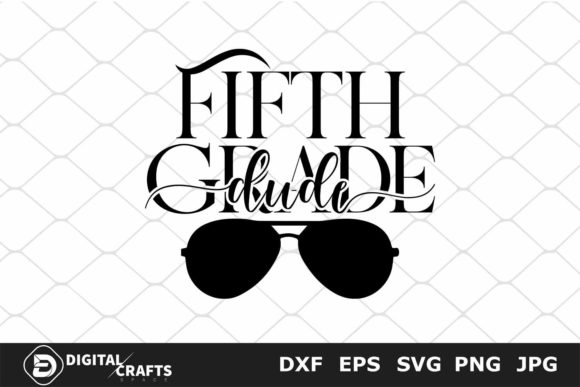
At its core, the Fifth Grade Dude, Back to School SVG is a digital design file—or more accurately, a set of five file formats bundled together in a single zip folder. The design itself is built around a fifth-grade theme, typically featuring a school-aged character or motif that resonates with students, parents, and educators. The phrase "Fifth Grade Dude" suggests a lighthearted, relatable image that can be used in a variety of crafting and decorating contexts.
What makes this product distinct is less about the artwork itself and more about the range of file types provided. Instead of offering just a single SVG file, you receive SVG, EPS, DXF, PNG, and JPG formats. This variety is intended to cover nearly every major cutting machine, design software, and print application on the market. For someone who uses multiple tools or shares designs with others who have different setups, that flexibility can be a significant advantage.
However, not every format is equally useful for every task. Understanding the strengths and limitations of each file type is essential to deciding whether this bundle aligns with your workflow.
SVG (Scalable Vector Graphics)
The SVG file is the primary format for most cutting machines, including Cricut Explore, Cricut Maker, and Silhouette Designer Edition. It is also compatible with Adobe Suite, Inkscape, Corel Draw, and other vector editing programs. Because SVG files store artwork as mathematical paths rather than pixels, they can be scaled to any size without losing quality. This makes them ideal for projects where you need to resize the design—such as applying it to a large poster or a small pencil case. The tradeoff is that SVG files do not handle complex photographic images well, but for a clean, graphic illustration like a back-to-school character, they perform excellently.
EPS (Encapsulated PostScript)
EPS is a vector format widely supported by professional design software. If you work in Adobe Illustrator, Inkscape, or Corel Draw, the EPS file offers similar scalability to SVG but with broader legacy support in print workflows. For someone who needs to open the design in older software or share it with a printing service that requests EPS, this format provides a reliable fallback. The downside is that EPS is less commonly used in direct cutting machine workflows, so you will likely use it more for editing and refinement than for the final cut.
DXF (Drawing Exchange Format)
DXF was originally developed by Autodesk for CAD applications, but it has found a niche in the crafting world, particularly for Silhouette Designer Edition users. If you have a Silhouette machine and prefer to work in that ecosystem, the DXF file can be a more seamless option than SVG. However, DXF files can sometimes have quirks with scaling or layer handling depending on the software version. For many crafters, SVG remains the more universal choice, but having DXF as an alternative gives you flexibility if your preferred program handles it better.
PNG (Portable Network Graphics) at 300 dpi
The PNG file is a high-resolution raster image with a transparent background. At 300 dpi, it is suitable for printing on items like t-shirts, mugs, and invitations where you want the design to appear crisp and clear. The transparency allows you to place the image on colored backgrounds without a white box around it. This is a strong option for digital mockups, social media graphics, or print-on-demand products. The limitation is that PNG is pixel-based, so enlarging it beyond its original dimensions will cause quality loss. For most craft and print projects, the provided resolution is sufficient, but if you plan to scale the design up significantly—say to a large banner—you are better off starting with the vector formats.
JPG (Joint Photographic Experts Group)
The JPG file is the most universally compatible image format, usable on virtually any device or platform without special software. It is included as a convenience for quick previews, reference images, or projects where a white background is acceptable. Because JPG uses lossy compression, it sacrifices some image quality to reduce file size, and it does not support transparency. For most serious projects, the PNG or vector formats will be preferable, but the JPG can be handy for sharing a quick look with a collaborator or client.
How This Compares to Other Back-to-School Design Options
When you search for back-to-school SVG files, you will encounter a wide range of offerings. Some sellers provide only a single SVG file, others bundle multiple formats like this one, and still others offer entire themed collections with dozens of designs. The Fifth Grade Dude, Back to School SVG sits in the middle ground: it is a single design with format variety rather than a multi-design bundle.
If you need many different designs for a classroom project or a large product line, a collection pack may be more cost-effective. On the other hand, if you have a specific project in mind—say, a t-shirt for your fifth grader on the first day of school—a single, well-supported design like this one gives you exactly what you need without extra files to sort through.
Another comparison point is between vector-only bundles and those that include raster formats. Some sellers offer only SVG and EPS, assuming users will convert them as needed. By including PNG and JPG, this bundle reduces the need for conversion steps, which is helpful if you are not comfortable with vector software or if you want to quickly test the design in a print layout.
The inclusion of DXF is worth special note for Silhouette users. Not every SVG bundle includes DXF, so if you are in the Silhouette ecosystem, this package may save you from having to convert files manually. However, many modern Silhouette versions can import SVG directly, so the DXF file is more of a convenience than a necessity for most users.
Strengths
- Cross-platform compatibility: With five formats, you can move between Cricut, Silhouette, Adobe, and print workflows without friction.
- High-resolution print option: The 300 dpi PNG is ready for print-on-demand services and home printing alike.
- Immediate use: No need to convert or re-save files for different tools—just unzip and pick the format you need.
- Scalability for vector users: The SVG and EPS files allow unlimited resizing without quality loss, which is critical if you plan to use the design across different product sizes.
Tradeoffs
- Single design: You get one theme, not a collection. If you need multiple variations or grade levels, you may need to purchase additional sets.
- JPG utility limited: The JPG format, while universally readable, lacks transparency and uses compression. Most users will rely on the PNG or vector files instead.
- No editable source files: The SVG and EPS are finished designs. If you want to modify colors or elements extensively, you will need to do that in a vector editor, and the ease of editing depends on how the file was constructed.
- Digital only: As a digital download, there is no physical product. You will need to supply your own materials—vinyl, t-shirt blanks, cardstock, etc.—and have the appropriate cutting or printing equipment.
When Is This the Right Choice?
The Fifth Grade Dude, Back to School SVG is a strong fit if you:
- Need a single, focused design for a fifth-grade back-to-school project.
- Use multiple devices or share files with others who have different software or machines.
- Prefer not to convert file formats yourself and want each option ready to go.
- Plan to use the design in both cutting and printing applications—for example, cutting vinyl for a t-shirt and printing the PNG for a matching card or sticker.
- Are a Cricut or Silhouette user who wants the flexibility to switch between SVG and DXF depending on which program performs better.
If your project calls for a broader set of designs—such as a full classroom bulletin board set with multiple grade levels—you may be better served by a multi-design bundle. Similarly, if you are a professional designer who needs fully layered, editable vector source files with separate colors and elements, you may want to look for a product that specifies editable AI or SVG layers. This bundle provides finished artwork, not a template for heavy customization.
When You May Need Another Option
No single SVG product fits every scenario. Here are a few situations where a different resource might serve you better:
- You need multiple grade levels or characters. This design is specific to a fifth-grade theme. If you are making items for siblings in different grades or for an entire class, look for a set that includes multiple designs or grade-specific files.
- You require commercial licenses for resale. Always check the terms of use for any SVG product. Some bundles include a commercial license, while others require separate purchase. This article does not specify licensing, so verify before using the design on products you intend to sell.
- You want a purely print-ready graphic with no cutting. If you only need the design for digital use or home printing, a single high-resolution PNG might be more economical. However, the PNG in this bundle is well-suited for that purpose, so it still works—it just comes with extra formats you may not use.
- You use software that does not support any of these formats. While the five formats cover a broad range, niche or older programs may still have compatibility gaps. In that case, you might need a universal PDF or a specific proprietary format.
Practical Comparisons: Realistic Examples
Consider two crafters: Mia uses a Cricut Explore Air 2 for vinyl cutting and occasionally prints iron-on transfers for t-shirts. She purchases the Fifth Grade Dude, Back to School SVG. For her t-shirt, she uses the SVG file in Cricut Design Space. For a matching sticker label on a water bottle, she uploads the PNG with transparent background to her print-then-cut project. The workflow is straightforward with no file conversion.
Now consider James, who runs a small print-on-demand shop. He needs to apply the design to multiple products—mugs, hoodies, tote bags—at different sizes. He uses the EPS file in Adobe Illustrator to scale and tweak the design, then exports the final version as a high-res PNG for his print provider. The EPS gives him the vector precision he needs for consistent scaling across product dimensions.
In both examples, the variety of formats supports different use cases without requiring extra steps. However, if Mia only wanted to cut vinyl and had no interest in printing, she might have been fine with just an SVG. And if James preferred to work exclusively in raster, he could have chosen a product that offers only a high-res PNG. The bundle adds value when you anticipate using the design in more than one way.
Decision Factors to Weigh
Before purchasing any SVG design bundle, consider these factors:
- Your primary tool: If you use Cricut, SVG is your go-to. If you use Silhouette, both SVG and DXF are useful. If you work in Adobe or Corel, SVG and EPS are the strongest options. Knowing your main tool helps you focus on whether the included formats actually benefit you.
- Your project scope: A single design is best for personal projects, small gifts, or a specific event. For larger batches or commercial product lines, a collection or a design with multiple variations may be more practical.
- The learning curve: If you are new to digital crafting, having both vector and raster formats can be reassuring because you can start with the PNG and gradually learn to use SVG or EPS as you grow more comfortable. The bundle supports a beginner-friendly ramp-up.
- File organization: Five formats in one zip folder is manageable for one design, but if you purchase multiple such bundles, you will need to keep your files organized. Some users prefer a single universal format for simplicity, while others appreciate having options.
Final Thoughts on Choosing the Right Back-to-School Design Resource
The Fifth Grade Dude, Back to School SVG is a well-rounded digital product that covers the most common crafting and printing workflows. Its strength lies in the variety of included formats, which reduces friction when moving between devices, software, and output methods. It is not a one-size-fits-all solution—no single design resource is—but it aligns well with the needs of crafters who value flexibility and want a single, focused theme for a fifth-grade milestone.
When evaluating any SVG product, consider your specific tools, the scope of your project, and whether the included formats match your typical workflow. Compare the tradeoffs between single-design bundles and multi-design collections, and always check licensing terms if you plan to sell finished items. By approaching the purchase with a clear understanding of what each format offers, you can choose a resource that saves you time and delivers results without unexpected limitations.
Whether you are making a one-of-a-kind t-shirt for your fifth grader, creating classroom decorations, or designing a small run of merchandise, the Fifth Grade Dude, Back to School SVG provides a practical foundation. Take a moment to assess your own needs, and you will be well on your way to a successful back-to-school project.