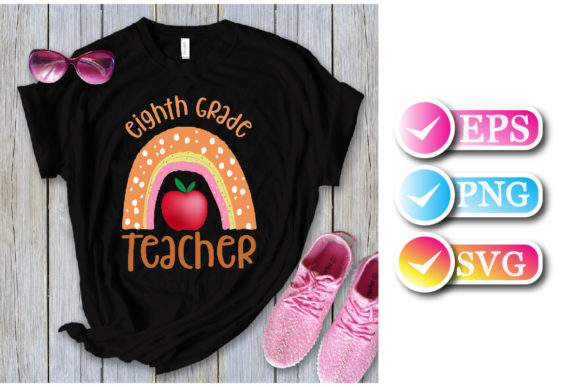
8th Grade Teacher Back to School: A Versatile Design Asset for Creators and Educators
Every August, educators and creators alike begin preparing for the new academic year. Among the many themes that emerge during this season, the 8th Grade Teacher Back to School design concept stands out as a particularly adaptable and meaningful visual asset. Whether you are a teacher looking to personalize your classroom materials, a small business owner producing print-on-demand merchandise, or a freelance designer building a seasonal portfolio, this design offers a practical foundation across a wide range of applications. This article evaluates the design's core characteristics, real-world usability, and the specific contexts where it delivers the most value.
Understanding the Design and Its Core Strengths
At its heart, the 8th Grade Teacher Back to School design typically centers on the transitional nature of eighth grade. Students at this level are no longer young children but are not yet high schoolers, making the theme resonate with both growth and anticipation. The design often incorporates grade-specific references, school-related imagery, and a tone that balances encouragement with a touch of maturity. What makes this design worth discussing is not just its thematic appeal but its structural flexibility.
Key characteristics that define a well-executed version of the 8th Grade Teacher Back to School design include clean typography, balanced composition, and a color palette that works across print and digital mediums. A strong design will avoid overly complex details that become problematic when resized for different products. Instead, it uses clear focal points and contrast to ensure legibility on everything from a small phone case to a large book cover. The most effective versions also incorporate layered elements such as icons, borders, or subtle textures that add depth without creating printing complications.
Practical Applications Across Product Categories
One of the primary reasons this design has gained traction among creators is its remarkable versatility. The same digital file can be adapted to produce merchandise for an entire classroom, a school store, or an online shop. Below is a breakdown of how the 8th Grade Teacher Back to School design performs across common product categories.
Apparel and Fabric-Based Items
T-shirts and hoodies are the most straightforward applications. For sublimation or heat transfer, the design should be mirrored and printed at a resolution that prevents pixelation on fabric grain. The 8th Grade Teacher Back to School design works particularly well on light-colored garments where contrast is easily maintained. For darker fabrics, designers should verify that any white or light elements have sufficient opacity or a white underbase. Tote bags and aprons also benefit from this design, especially when the layout includes a centered or left-chest placement that remains visible when items are carried or worn.
Hard Goods and Accessories
Mugs, phone cases, and vinyl decals demand a different set of considerations. On a curved mug surface, the design should occupy no more than two-thirds of the circumference to avoid distortion. The 8th Grade Teacher Back to School design often includes centered text or balanced motifs that translate well to this format. For phone cases, the design must accommodate camera cutouts and button placements while keeping the core message intact. Vinyl decals require clean outlines and minimal fine detail, since cut machines rely on vector paths. A version of the design with thick, connected lines ensures clean weeding and durable adhesion.
Paper Goods and Home Decor
Sign making, cards, invitations, and iron-on transfers all benefit from a design that maintains resolution at various sizes. For large signs, the 8th Grade Teacher Back to School design should be scalable without losing sharpness. This is where vector-based source files are far superior to raster images. Invitations and greeting cards allow for more playful arrangements, such as placing the design on the front cover with a blank interior for custom messages. Iron-on transfers require the design to be flipped horizontally, which is a simple adjustment if the original file is layered and editable.
Evaluating Quality, Usability, and Consistency
Not all versions of the 8th Grade Teacher Back to School design are created equal. When evaluating a specific design file for purchase or use, several factors determine whether it will perform reliably across different production methods.
File format and resolution are the most critical quality indicators. A professional design should include at least one vector format such as SVG, EPS, or AI. This allows scaling to any size without quality loss. If only raster formats are provided, a minimum resolution of 300 DPI at the largest intended use size is necessary. For cut machines, SVG or DXF formats are essential, and the design should include closed paths and no overlapping lines that confuse the cutting software.
Color consistency is another distinguishing factor. A well-prepared 8th Grade Teacher Back to School design should use a limited, intentional color palette that reproduces accurately across CMYK (for print) and RGB (for screens). If the design contains gradients or transparencies, these should be flattened or converted to solid color layers when preparing files for screen printing or vinyl cutting. For sublimation, the design should account for the way colors shift on polyester substrates, typically requiring slightly higher saturation and contrast.
Usability also depends on how the design is organized. The best assets include separate files for different purposes: one for print, one for cut machines, and one for digital use. Layered files allow the user to isolate individual elements, change colors, or remove certain components depending on the product. For example, a teacher creating both a t-shirt and a classroom poster might want to use the full design on the shirt but only the text portion on the poster. A well-structured file supports this kind of flexibility.
Who Benefits Most from This Design Asset
The 8th Grade Teacher Back to School design serves a diverse audience, but its value is highest for specific user groups.
Classroom Educators and School Staff
Teachers who want to create a cohesive visual identity for their classroom will find this design immediately useful. It can be printed on name tags, welcome banners, assignment folders, and bulletin board headers. The design also functions well as a template for parent communication materials, such as newsletters or open house invitations. Because eighth grade is often a milestone year, many teachers appreciate having a design that reflects the significance of the transition without being overly sentimental or childish.
Print-on-Demand Entrepreneurs
For small business owners running shops on platforms like Etsy, Redbubble, or Amazon Merch, this design offers a strong seasonal product line. The back-to-school period is a concentrated sales window, and designs that clearly target a specific grade and role tend to convert better than generic school designs. The key is to offer the 8th Grade Teacher Back to School design in multiple product formats, since different customers prefer different items. A shopper looking for a thank-you gift for a child's teacher may choose a mug, while another shopper might want a hoodie for themselves. A single design file that supports both use cases improves inventory efficiency.
Freelance Designers and Content Creators
Designers who create resources for other creators can build entire bundles around this theme. Combining the 8th Grade Teacher Back to School design with matching patterns, borders, and additional graphics increases the perceived value of a product bundle. Designers should also consider offering variations that include different teacher names or classroom themes, allowing buyers to customize the asset for their specific needs. This approach reduces the likelihood of returns and increases customer satisfaction.
Real-World Performance and Practical Limitations
No design is without constraints. In practice, the 8th Grade Teacher Back to School theme faces distinct challenges depending on the production method and the intended audience.
Print fidelity is a common issue when the design is used at very small sizes. On items like keychains, badge reels, or small decals, fine text or intricate icons may become illegible. Designers should include a simplified version of the asset for small-format applications, or recommend a minimum size for proper reproduction. Similarly, when printing on dark fabrics using heat transfer, the design may require a white layer behind it. Users who are not familiar with this process might be disappointed with the result if the file does not include a separated white layer.
Audience perception is another factor. While many eighth-grade teachers appreciate designs that celebrate their specific role, some may prefer a more understated look for professional settings. The best iterations of the 8th Grade Teacher Back to School design allow for tonal variation. A version with muted colors and minimal graphics will appeal to a different segment of the market than a bright, bold version. Offering multiple colorways or layout options helps address this range of preferences without requiring entirely separate designs.
Seasonality also affects long-term value. The design's peak relevance occurs between late July and mid-September, with limited appeal during the rest of the year. Educators and creators who plan to use the design beyond this window may want to consider how it can be adapted. For instance, removing the "Back to School" text leaves a more evergreen classroom design that works for open houses, parent-teacher conferences, or end-of-year events. A truly versatile asset includes editable text layers that let the user customize the message.
Practical Recommendations for Maximum Value
To get the most out of a 8th Grade Teacher Back to School design, consider the following strategies based on your specific role and project goals.
- If you are a classroom teacher, prioritize getting the design in a high-resolution PNG and SVG format. Use the SVG for cutting classroom decorations and the PNG for quick printing on sticker paper or cardstock. Laminate printed items for durability throughout the school year.
- If you are a print-on-demand seller, test the design on at least three product types in different price tiers. A lower-priced sticker or magnet, a mid-range mug or tote bag, and a higher-priced hoodie or spiral notebook cover will help you gauge which products your audience prefers. Monitor return rates for items where print size or placement might be an issue.
- If you are a content creator selling digital assets, include at least four file types: a layered vector file (AI or EPS), a single-layer PNG with transparency, an SVG for cut machines, and a PDF for print projects. Write clear instructions about which file to use for each application, especially regarding mirroring for heat transfers and color space settings.
- For all users, verify that the color palette of the design aligns with your school's branding or your shop's aesthetic. A design that uses school colors will always have a stronger emotional connection for teachers, while a neutral palette will appeal to a wider audience on a marketplace.
The long-term value of this design asset depends on how well it fits into your existing workflow and how much flexibility the file provides. A design that you can adapt, resize, and recolor will serve you far beyond a single back-to-school season. When you find a version of the 8th Grade Teacher Back to School design that meets these criteria, it becomes not just a seasonal decoration but a reliable resource for multiple creative projects across the academic calendar. Whether you are preparing a classroom, launching a product line, or building a portfolio of teacher-themed graphics, the right design will save you time and deliver consistent, professional results.